
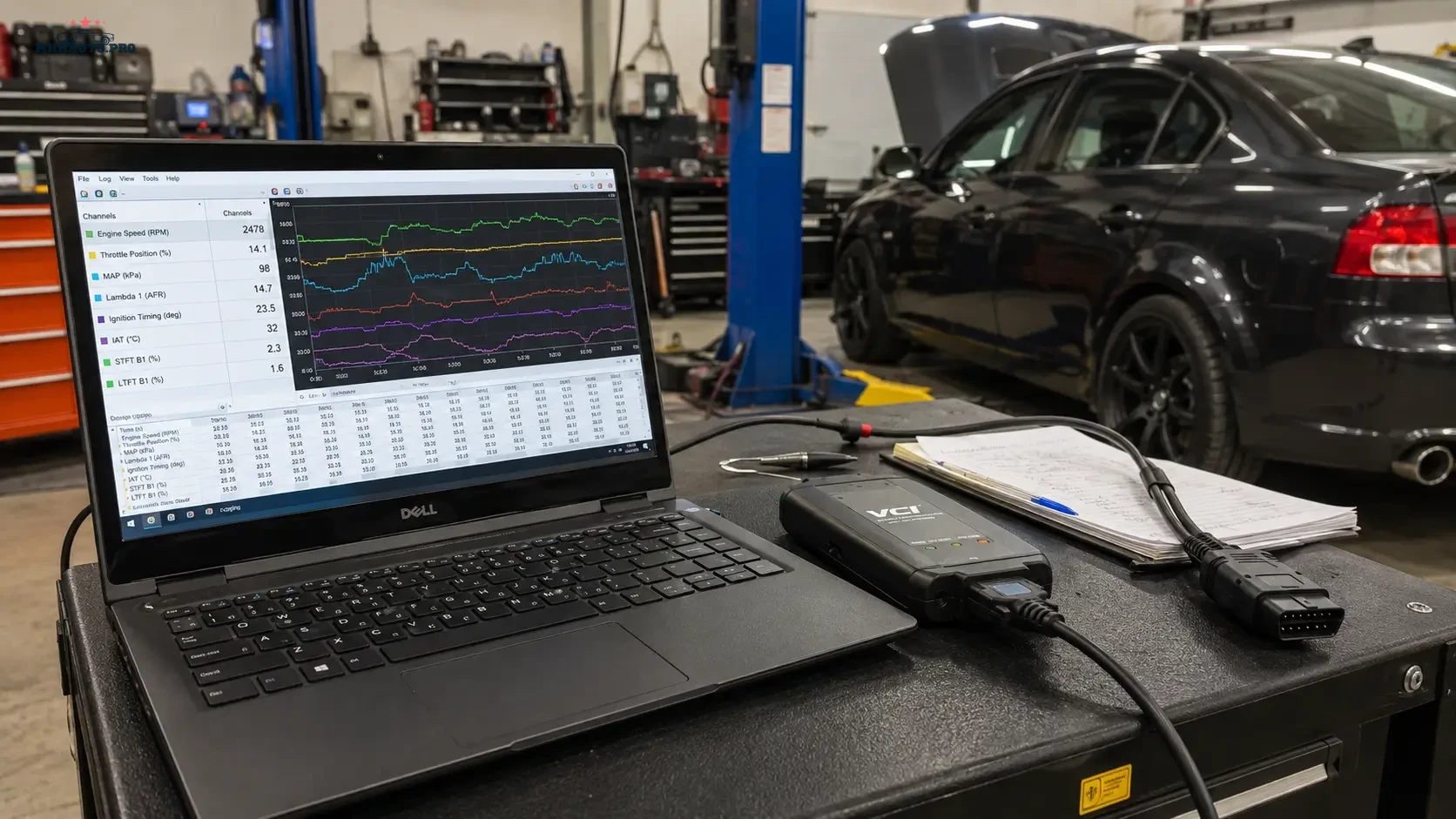
A good calibration starts with a known vehicle
Opening an ECU file is not the first step in a professional tuning job. The first step is establishing how the vehicle behaves before anything is changed.
A baseline datalog records the condition of the engine, transmission and supporting systems under controlled operating conditions. It gives the tuner a reference for requested and actual values, temperatures, fuel delivery, airflow, torque intervention and fault status. Without that reference, it is easy to mistake a mechanical problem for a calibration problem or to “improve” a file that was compensating for an existing defect.
The purpose of baseline logging is not to collect every parameter available in the scan tool. It is to collect the right parameters for a specific question and to produce a test that can be repeated after the calibration is changed.
What a baseline log should prove
A useful baseline should help answer four practical questions:
- Is the vehicle mechanically healthy enough for calibration work?
- Does the ECU achieve the values it requests?
- Are any control systems intervening because of temperature, knock, fuel pressure or torque limits?
- Can the same test be repeated after the file is modified?
If the log cannot answer these questions, it may contain a lot of data but still have little diagnostic value.
Record the vehicle configuration before logging
Two vehicles with the same model name can produce different results because of software versions, hardware changes, fuel quality or previous repairs. Create a short vehicle record before the first run.
Include:
- vehicle make, model and model year;
- engine code and transmission type;
- ECU and TCU identification where relevant;
- ECU hardware and software numbers;
- current mileage;
- fuel type and fuel grade;
- known engine or exhaust hardware changes;
- tire size if road-speed comparison matters;
- diagnostic tool and software version;
- ambient temperature and test date.
Do not rely on the customer description alone. A vehicle presented as “completely standard” may already contain an unknown file, aftermarket hardware or an earlier repair that affects the result.
Run a full diagnostic scan before the first pull
A pre-scan should be saved before road or dyno testing. Current, pending and history faults can explain behavior that would otherwise be blamed on the calibration.
Review the scan for:
- misfire or combustion faults;
- airflow and boost-control faults;
- fuel-pressure deviations;
- temperature sensor plausibility faults;
- communication faults;
- transmission faults and torque-reduction requests;
- low-voltage events;
- emissions-system faults that indicate an underlying mechanical problem.
Clearing faults before saving the original scan removes useful evidence. Document first, then decide whether the vehicle is ready for testing.
Do not tune around a mechanical defect
A calibration cannot repair a leaking charge pipe, weak fuel pump, contaminated airflow sensor, worn ignition component or unstable electrical supply. It may hide the symptom temporarily, but the vehicle will remain unreliable.
Baseline logging should be postponed when the vehicle has:
- active misfires;
- unexplained fuel-pressure loss;
- boost leaks or damaged intake hoses;
- abnormal smoke or oil consumption;
- unstable battery or charging voltage;
- overheating;
- unknown ECU software;
- transmission slip or serious transmission faults;
- poor-quality or incorrect fuel.
Repairing these issues first produces a cleaner baseline and reduces the risk of creating a file that only works around a temporary fault.
Define the question before selecting channels
Logging every available channel can reduce sample quality and make the result difficult to read. Start with a specific question.
Examples:
- Does actual boost follow requested boost?
- Does fuel pressure remain stable as load rises?
- Is the ECU reducing torque because of intake temperature?
- Is ignition correction isolated to one cylinder or present across all cylinders?
- Is throttle closure limiting delivered load?
- Does the transmission request torque reduction during the event?
Once the question is clear, select only the channels needed to answer it.
Core context channels
Every log needs enough context to show where the event happened. Parameter names vary between manufacturers and diagnostic tools, but the basic group usually includes:
- engine speed;
- vehicle speed;
- selected or calculated gear;
- accelerator pedal position;
- throttle angle where available;
- calculated engine load;
- coolant temperature;
- intake-air temperature;
- ambient or barometric pressure where relevant.
Without these channels, an isolated pressure or ignition value may be impossible to interpret correctly.
Airflow and boost-control channels
For turbocharged engines, requested-versus-actual comparison is more useful than actual pressure alone. A high or low value only becomes meaningful when it is compared with the ECU target and control effort.
Useful channels can include:
- requested manifold or boost pressure;
- actual manifold or boost pressure;
- mass airflow;
- requested and actual load;
- wastegate or boost-control duty;
- variable-geometry actuator command where applicable;
- throttle angle;
- charge-air temperature.
Be clear whether the tool displays absolute pressure, relative pressure or another calculated value. A unit misunderstanding can make a normal log look completely wrong.
Fuel-system channels
The appropriate fuel channels depend on engine type and ECU strategy. Do not apply one generic parameter list to every vehicle.
Useful petrol-engine channels may include:
- commanded lambda or equivalence ratio;
- measured lambda where supported;
- short-term and long-term fuel correction;
- low-pressure fuel supply;
- requested and actual high-pressure fuel values;
- injector duration or calculated fuel quantity.
Useful diesel-engine channels may include:
- requested and actual rail pressure;
- injected quantity;
- injector correction values where diagnostically relevant;
- air mass;
- requested and actual torque;
- exhaust-temperature values when available.
A single fuel-pressure drop can be caused by several systems. Review the complete event before concluding that a map is responsible.
Ignition, knock and torque-intervention channels
On a petrol engine, timing data should be reviewed with load, temperature, lambda and fuel quality. Looking only at one ignition channel can lead to the wrong conclusion.
Useful channels can include:
- ignition advance;
- cylinder-specific knock correction where supported;
- global ignition correction;
- requested torque;
- delivered or calculated torque;
- torque limiter status;
- throttle intervention;
- transmission torque request;
- temperature-related protection status.
A brief correction event is not automatically evidence of a bad calibration. Look for repeatability, cylinder pattern, operating condition and whether the event appears in more than one run.
Protection and temperature channels
Many modern ECUs modify torque, boost, airflow or ignition according to thermal models and protection functions. A vehicle may perform normally on the first run and reduce output on the next run because the operating conditions changed.
Depending on the platform, record:
- coolant temperature;
- engine-oil temperature;
- intake-air temperature;
- transmission temperature;
- measured or modeled exhaust temperature;
- catalyst temperature where available;
- thermal protection or component-protection status.
Temperature data is essential when comparing two runs. A faster second run is not meaningful if the first was performed with a heat-soaked engine and the second with cooler intake conditions.
A practical channel-selection table
| Question | Minimum useful channels | Common interpretation mistake |
|---|---|---|
| Is boost control stable? | RPM, pedal, requested boost, actual boost, control duty, throttle, intake temperature | Looking at actual pressure without the requested target |
| Is fuel delivery limiting load? | RPM, load, requested pressure, actual pressure, lambda or fuel quantity | Blaming the file before checking supply and hardware |
| Is ignition being reduced? | RPM, load, advance, cylinder correction, lambda, intake temperature | Treating one isolated correction as a repeated trend |
| Is torque being limited? | Pedal, requested torque, delivered torque, throttle, limiter or intervention status | Assuming low boost is the root cause rather than the result |
| Is heat affecting performance? | RPM, load, coolant, intake, oil and exhaust temperatures, protection status | Comparing runs made under different thermal conditions |
Fewer channels can produce a better log
Diagnostic tools have limited communication bandwidth. Selecting too many channels may reduce update frequency, create gaps or make fast events difficult to see.
Use a two-stage approach:
- Run a broad diagnostic log to identify the affected system.
- Run a narrower high-quality log with the channels needed for that system.
Keep the same channel list when comparing the stock and modified file. Changing the list between runs can make the two tests harder to align.
Make the test repeatable
A baseline is only useful when the post-calibration test can be performed under similar conditions.
Record:
- test route or dyno procedure;
- starting engine speed;
- selected gear;
- pedal application method;
- fuel used;
- ambient temperature;
- starting coolant and intake temperatures;
- vehicle load;
- traction or drive mode;
- time allowed between runs.
Do not conduct a road log while trying to operate a laptop at the same time. Use a second technician, secure automatic logging or a controlled dyno environment. Follow local road and safety rules.
Use a simple run sheet
| Field | Example entry |
|---|---|
| Run ID | BASE-01 |
| File state | Original / verified stock |
| Fuel | Customer-reported grade, confirmed where possible |
| Test condition | Controlled road or dyno run |
| Starting temperatures | Coolant, intake and oil values |
| Purpose | Requested versus actual boost comparison |
| Result | Stable / deviation found / test stopped |
How to review the finished log
Begin with the event as a whole. Confirm the run starts and ends where expected, the pedal input is clear and the engine follows a consistent speed range.
Then review:
- Target versus actual: does the controlled value follow the ECU request?
- Control effort: is the actuator command reasonable or already at its operating limit?
- Intervention: did throttle, torque control, knock control or thermal protection alter the result?
- Temperature: were conditions stable enough for comparison?
- Repeatability: does the same pattern appear in another run?
Do not build a calibration decision around one unexplained spike. Confirm the pattern and compare it with related channels.
Compare the modified file against the same baseline
After a controlled file change, repeat the same test with the same channel list and similar operating conditions. Label the log with the exact file version used.
The comparison should show more than peak output. Review:
- whether actual values follow requested values more accurately;
- whether control duty remains within a reasonable operating range;
- whether temperatures rise faster;
- whether torque intervention appears;
- whether fuel pressure and lambda remain stable;
- whether new diagnostic faults are stored;
- whether the result is repeatable.
A file that produces one strong run but creates unstable control or excessive thermal intervention is not a finished calibration.
Using forum research without replacing measurement
Forum discussions can help identify manufacturer-specific channel names, known logging limitations and common diagnostic patterns. For broader ECU and diagnostic research, review MHHAuto forum access. For ECU, firmware and calibration-focused discussions, review CarTechnology forum access.
Use forum information to improve the test plan, but use the vehicle log to make the final decision.
Baseline datalogging checklist
- Confirm vehicle, engine, ECU and software identification.
- Record hardware and fuel information.
- Save a complete pre-scan.
- Repair active mechanical and electrical faults first.
- Define one diagnostic question for each log.
- Select requested, actual, control and temperature channels.
- Keep the channel list small enough for useful update quality.
- Record the test condition and starting temperatures.
- Repeat suspicious events before drawing a conclusion.
- Use the same procedure for the post-calibration test.
- Save the final scan and label every log with its file version.
FAQ
How many channels should be recorded in one ECU log?
There is no universal number. Use enough channels to answer the test question without reducing data quality. A focused log is usually easier to interpret than a large list of unrelated parameters.
Can a baseline log confirm that the ECU file is original?
No. A log can show how the vehicle behaves, but it cannot prove file originality by itself. ECU identification, file comparison and software-version checks are still required.
Should fault codes be cleared before the baseline run?
Save the complete pre-scan first. Active faults that affect engine, transmission, fuel, airflow or temperature control should normally be diagnosed before tuning work continues.
Is one successful road log enough?
Not usually. Important conclusions should be confirmed with a repeated test under similar conditions. One run may be affected by traffic, temperature, gear selection or temporary intervention.
What is the most important baseline comparison?
Requested-versus-actual values are central, but they must be reviewed with control effort, temperature and intervention status. One parameter rarely explains the entire event.
A baseline datalog is the technical reference for the whole tuning job. It shows whether the vehicle was healthy, what the ECU requested, what the hardware delivered and whether the result can be repeated after the calibration is changed.