
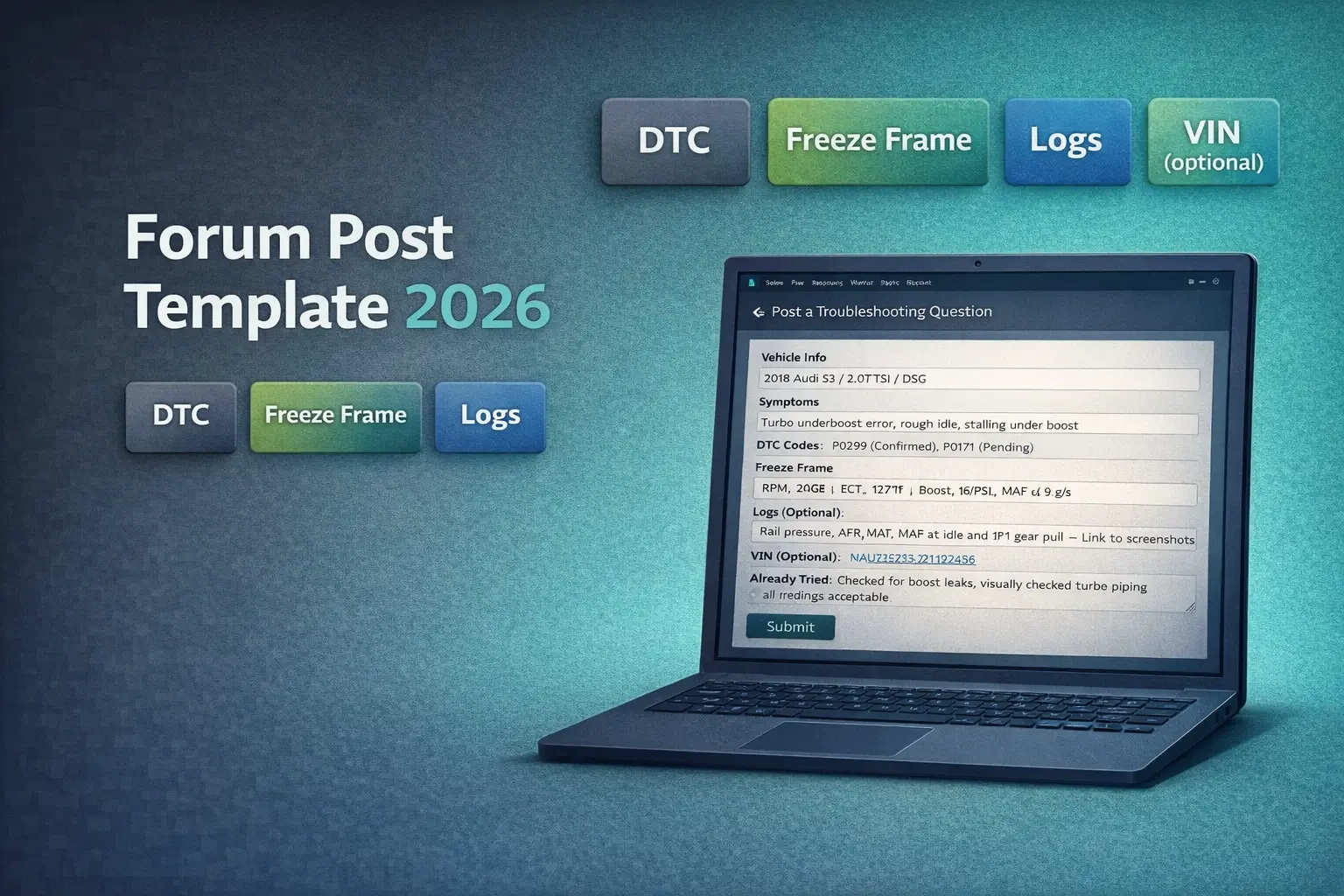
Stop Getting “Need More Info” Replies
If your thread starts with “car runs bad, please help,” you’ll either get ignored or spend 20 messages answering basic questions. A good post gives people enough data to think, not guess. The goal is simple: make it easy for someone experienced to reply with a real diagnostic direction on the first page.
Below is a practical checklist and a copy-paste template you can use on any automotive forum (diagnostics, tuning, coding, wiring). Fill it in once, and your chances of getting useful answers go way up.
1) The minimum info every forum needs
- Vehicle: year, make, model, engine code, transmission (manual/auto/DSG), mileage
- Market/region: US/EU/Asia (sometimes changes ECU, wiring, emissions equipment)
- Mods/tuning status: stock, tuned, hardware changes (DP, turbo, injectors, intake, EGR/DPF changes, etc.)
- Recent work: what was touched right before the problem started (battery, alternator, timing, plugs, fuel system)
2) Describe the symptom like a tech, not like a meme
Bad: “It shakes” / “No power” / “Weird noise.”
Good: describe when it happens and what changes it.
- When: cold start, hot idle, under load, highway cruise, WOT pull, after refuel
- How repeatable: always, once a day, only in rain, only after long drive
- What affects it: RPM range, throttle position, gear, AC on/off
3) DTCs: post them correctly
- List all codes with status: Confirmed / Pending / Stored
- Include the module: ECU / TCU / ABS / BCM
- If you cleared codes, say it (and how fast they came back)
4) Freeze-frame data is gold
If you have freeze-frame, paste the key fields. Even a short set helps:
- RPM
- Vehicle speed
- Coolant temp (ECT)
- Load / throttle
- Boost / MAP (if relevant)
- Fuel trims (STFT/LTFT) where available
5) Logs: keep them small and focused
Don’t dump 200 channels and expect strangers to work for you. Log only what matters for the symptom.
- Misfire/rough idle: misfire counters, STFT/LTFT, MAF, MAP, lambda/AFR, ignition timing
- Underboost/overboost: requested vs actual boost, N75/wastegate duty, MAP, RPM, throttle
- Fuel pressure issues: requested vs actual rail pressure, LPFP pressure, injector pulse, lambda
Attach screenshots or a file link and specify the exact test: “3rd gear pull 2000–6000 RPM” or “hot idle 2 minutes.”
6) Tell people what you already tried
This prevents useless replies and helps others build on your work.
- Parts replaced (with brand and mileage on parts)
- Smoke test / pressure test results
- Voltage/charging check
- Swaps you performed (coil packs, injectors, sensors)
7) Copy-paste forum template
Use this block as your first post and fill it in:
Vehicle:
Year / Make / Model:
Engine code / ECU:
Transmission:
Mileage:
Region/Market:

Mods / Tune:
(Stock / Stage / Hardware list)

Problem:
(What happens, when it happens, how often)

DTCs (with status + module):
- Code:
- Code:

Freeze-frame (key values):
RPM:
Speed:
ECT:
Load/Throttle:
Boost/MAP:
Fuel trims:
Other:

Logs (what channels + test):
(Test type: idle / cruise / pull / etc.)
(Attach link/screenshots)

Already tried:
-
-

Recent work before issue started:
-

Goal:
(What you want to achieve: fix drivability, pass emissions, confirm diagnosis, etc.)
Conclusion
Forums can be incredibly effective — but only if you provide enough signal. Post clear vehicle info, accurate codes, freeze-frame, and a focused log, and you’ll get answers that feel like professional diagnostics instead of random guessing.